
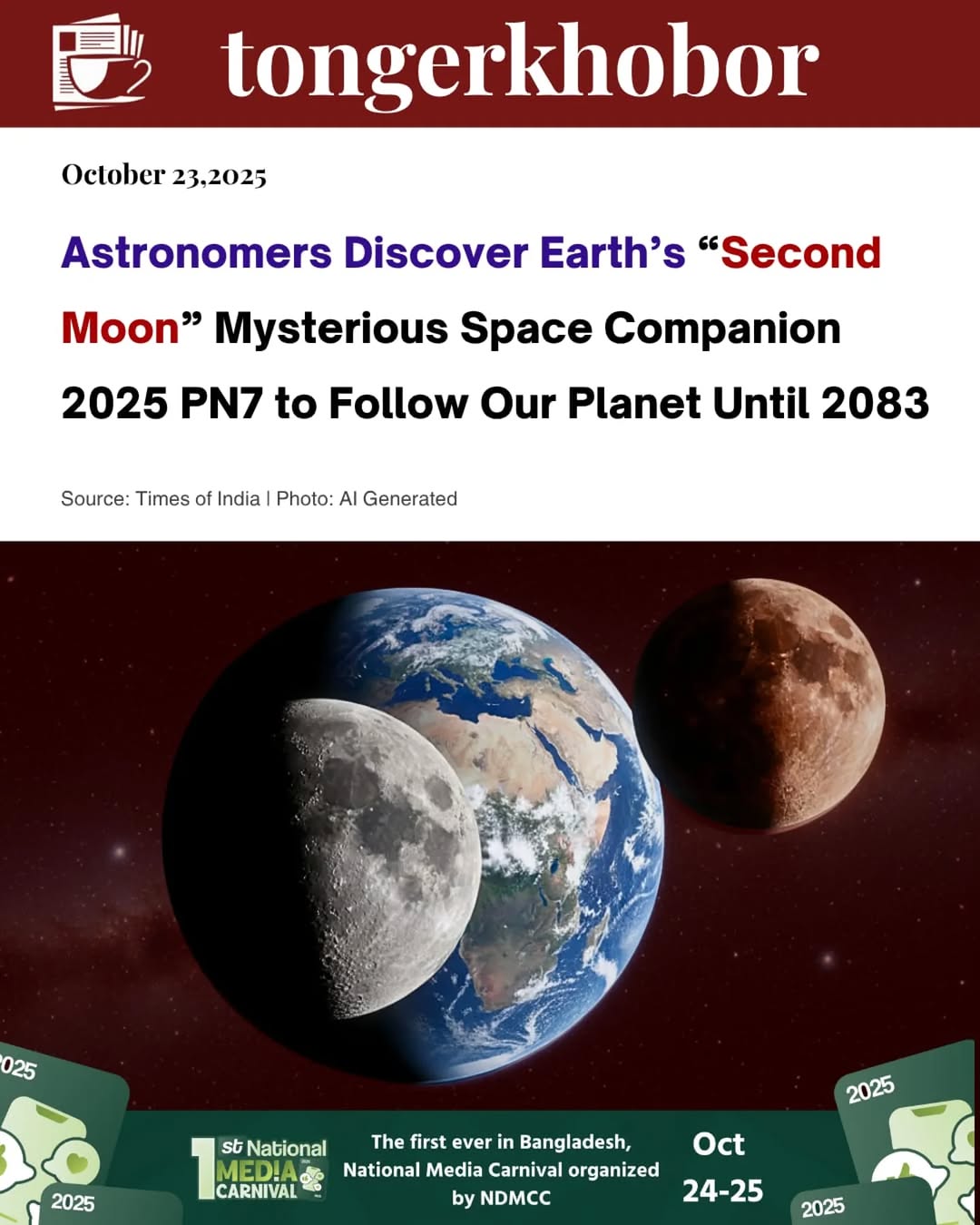
Astronomers have discovered a new near-Earth object named 2025 PN7, which NASA has classified as a quasi-satellite — effectively making it a “second moon” of Earth, though not in the traditional sense.
The object, measuring 18–36 meters across, follows an Earth-like orbit around the Sun instead of orbiting Earth directly. This synchronized movement, known as a 1:1 orbital resonance, makes it appear to travel alongside our planet.
Detected by the Pan-STARRS survey in Hawai‘i, 2025 PN7 is expected to stay in this co-orbiting pattern until around 2083, before drifting away due to gravitational shifts.
Though too faint to be seen with the naked eye, the discovery offers scientists a rare chance to study near-Earth asteroids and the complex dance of orbital mechanics.
Source: Times of India
#NASA #SpaceDiscovery #Astronomy #SecondMoon #2025PN7 #ScienceNews #SpaceExploration